
S2526
Public Space and Protest Power
Public space and protest power explores how protest movements do more than express political demands; they actively reshape the city itself. Through the ongoing student protests in Serbia, the series explores how public space becomes a site of visibility, conflict, solidarity, and collective identity. Beginning with the Novi Sad railway station canopy collapse and the institutional silence that followed, the podcast examines how grief turned into mobilization, and how student-led organizing transformed protest into a recurring urban rhythm. Across both episodes, protest is approached as an urban practice: something that reorganizes streets and squares, redefines everyday routines, and turns ordinary infrastructure into political terrain. By connecting political experience to spatial experience, Public space and protest power shows how democracy is not only debated. It is performed, negotiated, and made visible through the urban space.
Part A – From Collapse to Collective: Student Protest in Serbia
From Collapse to Collective: Student Protest in Serbia begins in Novi Sad, where the sudden collapse of a recently renovated railway station canopy turns a normal morning into a moment of collective shock. As accountability fails to arrive and justice remains suspended, the tragedy becomes more than an accident – it becomes a symbol of institutional breakdown. From this rupture, a student-led protest movement emerges, expanding across universities and cities and transforming grief into organization. The episode follows how students, supported by professors and structured through direct democratic plenums, became central actors in demanding transparency, responsibility, and the rule of law. Positioned within both Serbia’s political climate and the longer global history of student movements, the episode asks why students so often become catalysts for change, and why their protests matter not only politically, but urbanistically as well. It raises an important question: what happens when protest becomes part of the city’s fabric?
Part B – Public space, public power: How protest reshapes a city
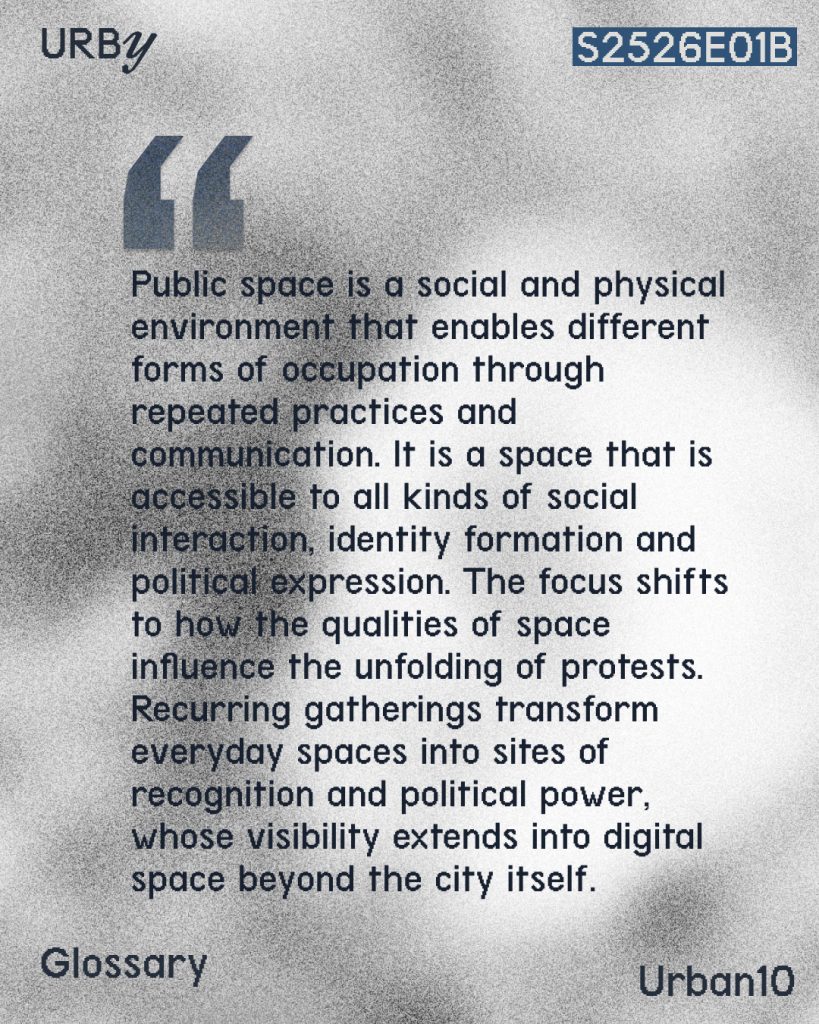
Public space, public power: How protest reshapes the city shifts the lens from protest as a political movement to protest as a spatial force. As demonstrations become recurring in Serbia, they begin to settle into the city’s everyday rhythm, reshaping how people move, gather, and relate to the spaces around them. Drawing on the Charter of Public Space and conversations with scholars and practitioners, the episode explores how public spaces gain visibility, symbolic power, and political function during protest. From Beirut to Madrid to Belgrade, it traces how repeated occupation can transform ordinary streets and squares into sites of memory and identity. The episode also examines how protest communication now extends beyond physical space into digital space, allowing visibility to travel and meanings to circulate. Ultimately, the main argument is that public space is not merely where protests take place. It is one of the central stakes of protest itself, and one of the last arenas where democratic presence can become visible, collective, and real.
Subscribe on your favorite platform
Part A – From Collapse to Collective: Student Protest in Serbia
Part B – Public space, public power: How protest reshapes a city
Guests
Resources
Suggested readings
Part A – From Collapse to Collective: Student Protest in Serbia
Balkan Insight. (2025, October 30). How the Novi Sad station disaster changed a Serbian city. https://balkaninsight.com/2025/10/30/how-the-novi-sad-station-disaster-changed-a-serbian-city/
European Parliamentary Research Service. (2025). [Report title unavailable from URL]. European Parliament. https://www.europarl.europa.eu/RegData/etudes/ATAG/2025/775906/EPRS_ATA%282025%29775906_EN.pdf
Freedom House. (2024). Serbia: Freedom in the World 2024 country report. https://freedomhouse.org/country/serbia/freedom-world/2024
Linkiesta. (2025, October). Serbia: Proteste, Vučić, repressione, Europa, indifferenza. https://www.linkiesta.it/2025/10/serbia-proteste-vucic-repressione-europa-indifferenza/
Jacobs, J. (1961/1993). The death and life of great American cities. Vintage Books.
Milojević, I., & Pantić, N. (2025). Contesting authoritarianism: The role of youth-led movements in shaping futures in Serbia. Journal of Futures Studies. https://jfsdigital.org/contesting-authoritarianism-the-role-of-youth-led-movements-in-shaping-futures-in-serbia/
N1 Info. (n.d.). Student protests in Serbia continue amid incidents. https://n1info.rs/english/news/student-protests-in-serbia-continue-amid-incidents/
Reuters. (2025, March 15). Huge crowds join anti-government rally in Belgrade after sporadic violence. https://www.reuters.com/world/europe/huge-crowds-join-anti-government-rally-belgrade-after-sporadic-violence-2025-03-15/
Studentski Zahtevi. (n.d.). Studentski zahtevi. https://studentskizahtevi.rs/eng/
SUO. (n.d.). The history of student movements and why they still matter. https://www.suo.ca/blog/the-history-of-student-movements-and-why-they-still-matter/
The Lancet Regional Health – Europe. (2025). [Title not available from provided link]. The Lancet Regional Health –Europe. https://www.thelancet.com/journals/lanepe/article/PIIS2666-7762(25)00231-5/fulltext
Moroni, S., & Chiodelli, F. (2025). The relevance of public space [PDF]. In Less is Less. https://www.lessisless.it/wp-content/uploads/2025/12/P2013_SPRINGER_The-Relevance-of-Public-Space.pdf
Part B – Public space, public power: How protest reshapes a city
Charter of Public Space. (n.d.). International Network for Urban Development. https://inu.it/wp-content/uploads/Inglese_CHARTER_OF_PUBLIC_SPACE.pdf
Moroni, S. (2013). Ethics, design and planning of the built environment. https://www.researchgate.net/publication/321549773_Ethics_Design_and_Planning_of_the_Built_Environment
Gehl, J. (2010). Cities for people. Island Press. (Original work accessed via Google Books) https://books.google.it/books?hl=en&lr=&id=x8T7qheiI2oC&oi=fnd&pg=PR1&dq=public+space+&ots=RPnhP1p2yH&sig=r9OYOlKF2KyFN3Xa6sLxAQBASaI&redir_esc=y#v=onepage&q=public%20space&f=false
Jacobs, J. (1961/1993). The death and life of great American cities. Vintage. (Referenced in broader work on public space studies)
Mastering Public Space. (n.d.). Public spaces: More than just space. https://www.masteringpublicspace.org/public-spaces-more-than-just-space/
Madanipour, A., Hull, A., & Healey, P. (2017). Public space and the challenges of urban transformation in Europe. Journal of Urban Design, 22(3), 341–350. https://doi.org/10.1177/0095399719852897
Mitchell, D. (2003). The right to the city: Social justice and the fight for public space. Guilford Press. (Original work accessed via PDF) https://erikafontanez.com/wp-content/uploads/2017/09/mitchell-the-right-to-the-city.pdf
Montgomery, J. (2017). Toward a science of public space. Cities, 69, 56–60. https://www.sciencedirect.com/science/article/abs/pii/S0962629816302062
Low, S. (2025, October). What makes a good public space? Social Science Space. https://www.socialsciencespace.com/2025/10/setha-low-on-public-spaces/
N1 Direktno. (2025). Public space lecture [Video]. YouTube. N1 Direktno: O studentskom protestu u Beogradu (15.3.2025)