
S2526
Water in Conflict
Water in Conflict takes research produced in the Conflict Management and Resolution course and turns it into stories that can travel beyond the classroom. The stories are three, and they all deal with water and infrastructure. The first unfolds along the border between the United States and Mexico, where water debt becomes a political dispositif that displaces costs onto specific territories, such as the Mexican state of Chihuahua. The second is Venice, where the MOSE system of mobile flood barriers redefines the relationship between the city and the sea itself, transforming a historical condition into a technical (and therefore inevitably political) question. The third takes place in Denmark, where conflict is diffuse: everyday agricultural practices coming into tension with groundwater protection. Taken together, the three episodes show that conflicts over water are never just about water, but about power, infrastructure, and unequal access. In this sense, the series does not seek a unified explanation but assembles three perspectives that expose the uneven distribution of possibilities within trans-scalar territorial planning.
S252606
Below the Surface. Power, Groundwater, and BNBOs in Denmark
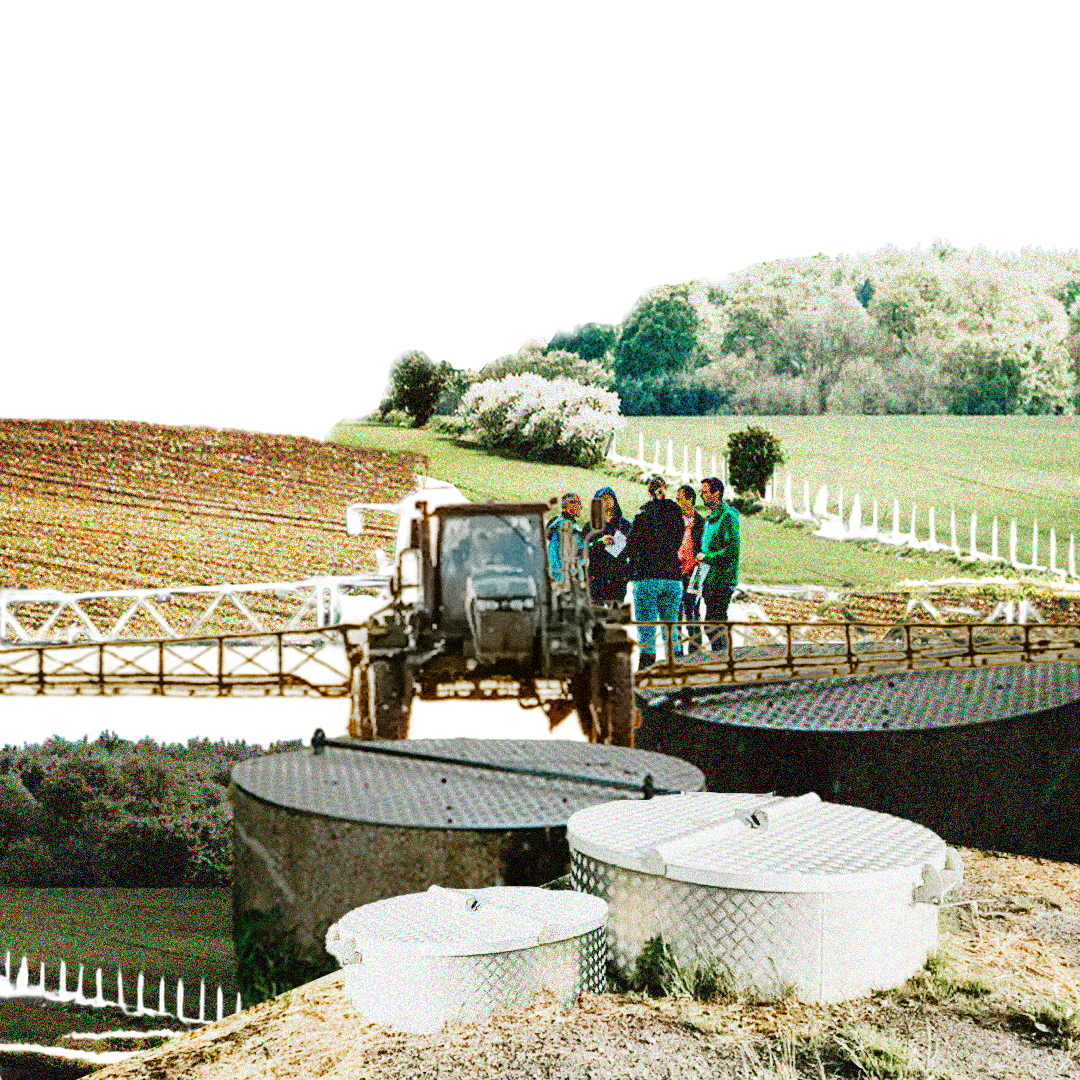
In Below the Surface, the case of groundwater protection in Denmark becomes an entry point to explore how environmental regulation can reshape agricultural life, as well as land ownership and land use. The episode focuses on BNBOs – protection zones around drinking water wells – examining how regulatory dispositifs are deployed and how they translate into concrete restrictions on land use. What appears as a neutral environmental measure, seemingly a straightforward product of scientific knowledge, is in fact a contested object. In an agricultural system structured by productivity and global markets, groundwater protection does not eliminate environmental costs but redistributes them, shifting the burden onto landowners, whose practices, margins, and autonomy are increasingly constrained. The episode ultimately raises a broader question: who gets to decide how land and water are used, and what forms of power are embedded inthe language of sustainability?
Subscribe on your favorite platform
Guests
Resources
Audio sources used
DR Nyheder. (2026). Drikkevandsdebatten er skoldhed, men har eksisteret i årtier [Video]. DR. https://www.dr.dk/nyheder/politik/reels/drikkevandsdebatten-er-skoldhed-men-har-eksisteret-i-aartier
DR Nyheder. (2026). På sjette døgn er borgerne i Ledøje uden vand: “Det er virkelig skræmmende” [Video]. DR. https://www.dr.dk/nyheder/indland/paa-sjette-doegn-er-borgerne-i-ledoeje-uden-vand-det-er-virkelig-skraemmende
DRTV_DR. (2026). Signe Molde drikker drænvand fra en mark med frisk sprøjtet gift [Video]. YouTube Shorts. https://www.youtube.com/shorts/NgMbySG4I8o
Selected references
Brønserud, B. (2018). 30 års miljøpolitik – en katastrofe!. Forlaget Himmerland.
Burton, R. J. F. (2004). Seeing through the ‘good farmer’s’ eyes: Towards developing an understanding of the social symbolic value of ‘productivist’ behaviour. Sociologia Ruralis, 44(2), 195–215.
Egedal Kommune. (n.d.). Boringsnære beskyttelsesområder (BNBO).
Foucault, M. (2007). Security, Territory, Population: Lectures at the Collège de France, 1977–1978. Basingstoke: Palgrave Macmillan.
Harvey, D. (2001). Spaces of Capital: Towards a Critical Geography. Edinburgh: Edinburgh University Press.
Linton, J. (2010). What Is Water? The History of a Modern Abstraction. Vancouver: UBC Press.
Menga, F., & Swyngedouw, E. (Eds.). (2018). Water, Technology and the Nation-State. London: Routledge.
Miljøstyrelsen. (n.d.). Status BNBO.
Smith, N. (1984). Uneven Development: Nature, Capital, and the Production of Space. Oxford: Basil Blackwell.
Strandmark Povelsen, C., Teilmann, C., Hauge Andersen, L., & Enø Lander, S. (2019). Sprøjtefrie boringsnære beskyttelsesområder som reguleringstiltag – påvirkning af aktører i Egedal Kommune. Project in Regulation, TekSam – Miljøplanlægning, Roskilde Universitet.